The Folland Gnat was a British compact swept-wing subsonic fighter aircraft that was developed and produced by Folland Aircraft in 1955.

The Museum’s Lysander is a full-size replica built in 2015 by Gate Guards UK Ltd.

Tangmere’s Harrier GR3, XV744, was built as a GR1 and took part in the Daily Mail Transatlantic Air Race in May 1969.

Built by Vickers Armstrong in the mid-1950s, WK281 joined No 79 Squadron at RAF Gutersloh, West Germany in April 1959 and was operated in the tactical fighter reconnaissance role until January 1961 when the squadron converted to the Hunter FR10.

WP190 was delivered to No 1 Squadron, Tangmere on 13th August 1955. When the Suez crisis erupted in August 1956, she deployed to Cyprus for five months with a Tangmere Wing of 25 Hunters for air defence duties.

Lightning ZF578 was delivered to Saudi Arabia in November 1968 and, after sterling service with the Royal Saudi Air Force, was finally recovered to the UK for disposal in January 1986.

This aircraft entered service with the Royal Navy in November 1960 as a Mk1 and served at sea with various Fleet Air Arm units until being converted to FAW2 status during the period 1963-65.

In 1968, XV408 was one of the first Phantoms delivered to the RAF. It served briefly with No 228 Operational Conversion Unit at RAF Coningsby and in June 1969 was allocated to No 6 Squadron, the first operational Phantom unit, for fighter/ground attack duties.

The Museum’s Sea Harrier, XZ459, was a Falklands War veteran which, as an FRS1, served with No 800 Naval Air Squadron aboard HMS Hermes in the South Atlantic.

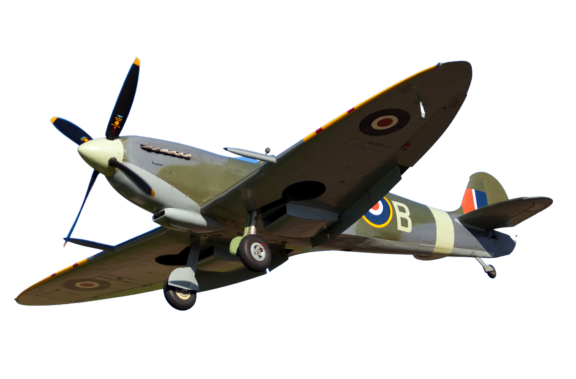
In 1983, the renowned Spitfire test pilot, Jeffrey Quill, decided that the contribution to military aviation by the designer R J Mitchell had never truly been recognised.

The original Hurricane L1679 was delivered to No 1 Squadron at RAF Tangmere in early 1939 and deployed with the unit to France on 9th September just 6 days after the outbreak of war.

The Vampire prototype made its maiden flight in September 1943 with Geoffrey de Havilland at the controls – only six months after the first flight of the Meteor.

The Hunter in which Neville Duke flew to secure his world air speed record of 727 mph in 1953. This unique aircraft was ordered in June 1948 as one of three prototypes and first flown by Hawker’s Chief Test Pilot, Squadron Leader Neville Duke, in July 1951.

The actual aircraft that captured the world air speed record of 616 mph in 1946. The RAF High Speed Flight was reformed in late 1945 at Tangmere in order to make an attempt on the world air speed record. In August 1946, it received Meteor F4 EE549 direct from the Gloster Aircraft Company.

The Wessex HU5 was designed as a commando-carrier assault helicopter. Capable of carrying 16 Royal Marines and their equipment, she entered service with the Royal Navy in 1964 and remained on the front line until 1986.

Canberra B2 (WE113) was initially delivered to No 231 Operational Conversion Unit at RAF Bassingbourn in June 1952.
test
test

Hunter F4 (WV332) was delivered to the RAF in 27 June 1955 and served in Germany on Nos 677 and 234 Squadrons before becoming a ground instructional airframe at RAF Halton in 1957.

Chipmunk T10 WZ876 was built in 1952 and served with the RAF as a primary trainer until 1970.

The Provost T1 was the last piston-engined basic trainer to be operated by the RAF.

The Royal Aircraft Factory SE 5a scout was one of the most successful British fighter aircraft of the First World War

The Spitfire Mk IX cockpit built by the Museum’s Special Projects Engineering team.

Tangmere's cockpit (J1649) is one of twenty four built by the Swiss as specialist reconnaissance/fighter bomber aircraft.

Constructed from a Link Trainer fuselage, this simulator imitates a Second World War fighter cockpit.
It incorporates a joystick with gun-firing button and uses a flight simulator program to enable the pilot to enter combat with, and ‘shoot down’ Luftwaffe aircraft.

Formally opened by Air Chief Marshal Sir William Wratten GBE CB AFC FRAeS CIMgt on Thursday, 22nd July 2010, Tangmere’s Lightning simulator was developed and constructed by a small project team of Museum volunteers.

Two Red Simulators are available for public use, one of which is fully compatible with wheelchair use. Each of them enables visitors to “fly” a number of different types of aircraft associated with Tangmere